How Many Marks Do You Need to Pass Theory Test Hazard Perception?
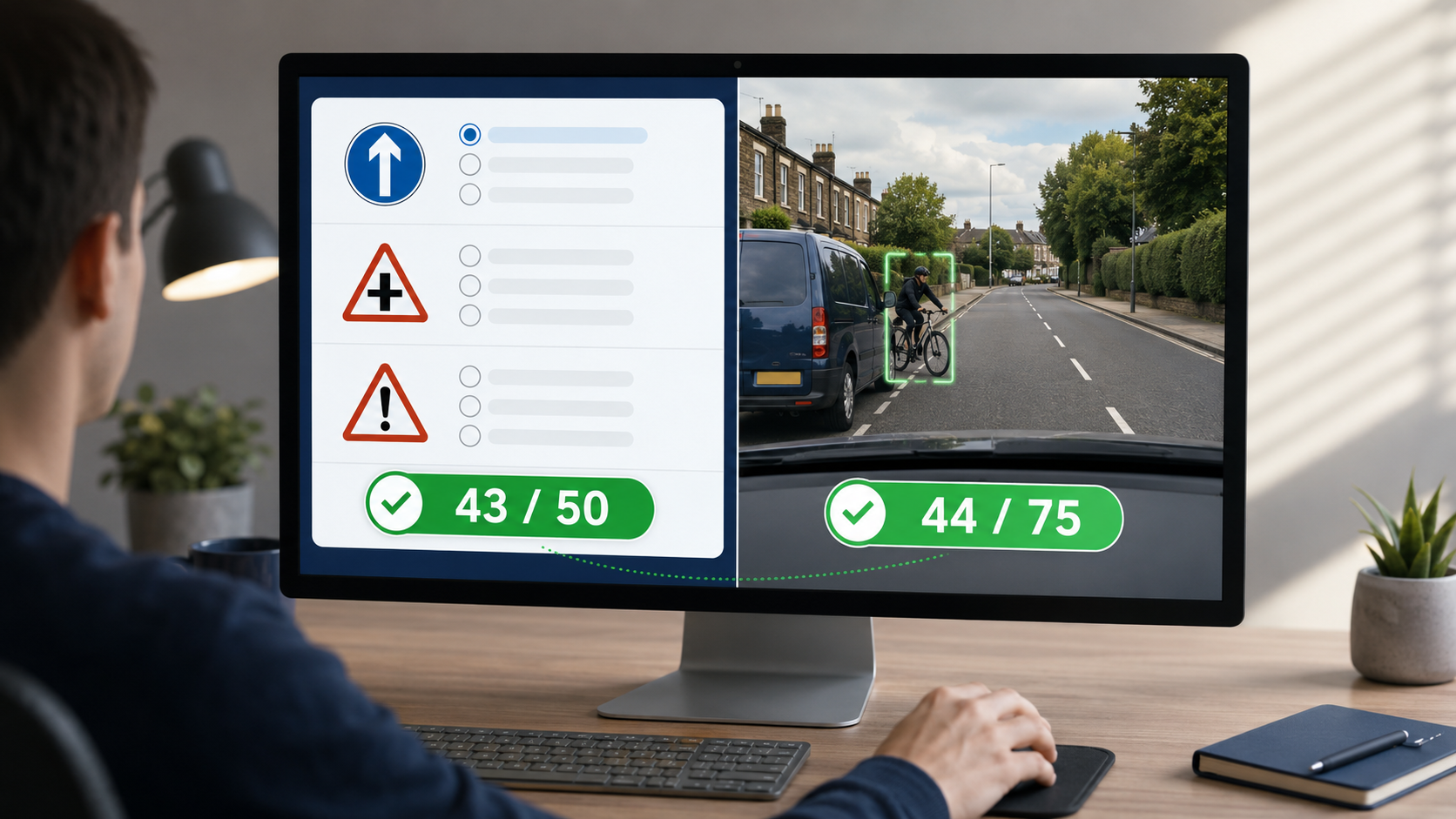
You need 44 marks out of 75 to pass the hazard perception part of the car theory test.
That works out at just under 59%.
That is the short answer. But there is one important thing to remember: you must also pass the multiple-choice part in the same test. You need 43 out of 50 for that section. A high score in one part cannot make up for a low score in the other.
So, if you get 44 or more in hazard perception but only 42 in the multiple-choice questions, you will fail the full theory test. The same happens if you pass the questions but score 43 in hazard perception.
How the hazard perception marks work
The hazard perception test has 14 video clips. They show normal road scenes from a driver's point of view.
Thirteen clips have one developing hazard. One clip has two developing hazards. This gives you 15 scored hazards in total.
You can get up to 5 marks for each developing hazard:
- 15 developing hazards
- Up to 5 marks for each one
- 75 marks available in total
- 44 marks needed to pass
Your total score across all the clips matters. You do not need to pass every clip on its own. For example, getting a low score on one clip does not mean you have failed. You can still make up those marks by spotting hazards earlier in other clips.
What counts as a developing hazard?
A developing hazard is something that may make you change speed, change direction or stop.
Imagine there is a parked car ahead. While it is sitting still, it is something to notice, but it may not yet be a developing hazard. If its indicator comes on and it starts moving into your path, the situation has changed. You may now need to slow down, so it has become a developing hazard.
Other simple examples include:
- A pedestrian starting to cross the road
- A cyclist moving around a parked vehicle
- A car beginning to pull out of a side road
- Brake lights appearing on the vehicles ahead
- A child moving towards the edge of the road
The key word is developing. Do not wait until the danger is directly in front of you. Click when you see that the situation is starting to change.
How many marks can you get for each hazard?
You can score from 1 to 5 marks for a developing hazard. The earlier you spot it after it starts to develop, the more marks you can get.
A good early click may earn 5 marks. If you notice the same hazard later, you may get 4, 3, 2 or 1 mark. If you click before anything is developing, or only react when the danger is already obvious, you may get no marks.
This is why hazard perception is not just about having quick reactions. It is about reading the road and noticing early signs.
Can you click more than once?
Yes. GOV.UK says you do not lose marks simply because you click and get it wrong. You also do not have to worry that one genuine extra click will automatically fail the clip.
However, do not click continuously or follow a repeated pattern. The system is designed to notice this, and you can score nothing if it looks as though you are trying to beat the test by clicking all the way through.
A simple approach is to click when you honestly see a hazard starting to develop. Keep watching the whole scene after you click. Remember that one of the clips contains a second developing hazard.
You only get one attempt at each clip. You cannot go back to review a clip or change your response.
Is 44 out of 75 a good practice score?
It is a pass, but it is not a comfortable practice target.
If you keep getting 44 or 45 in practice, a couple of late clicks on test day could bring you below the pass mark. Try to reach the mid-50s regularly before your real test. That gives you some room for nerves or one difficult clip.
Do not worry if your first scores are low. Hazard perception gets easier when you stop guessing and start looking for changes. Practise clips, check where the scoring window started, and learn why your click was early or late.
The Driving Theory Test UK app includes hazard perception practice alongside mock tests and progress tracking. You can also read our guide to how hazard perception scoring works for more help with click timing.
What happens if you fail hazard perception?
If you fail either part, you need to book and take the full theory test again. You cannot keep the pass from the multiple-choice section and only retake hazard perception.
GOV.UK says you must wait at least 3 working days before taking the test again. Your result letter will tell you which part you did not score enough marks on, so use it to plan your next round of practice.
Quick answers
How many marks do I need in hazard perception?
You need 44 out of 75 to pass the hazard perception part of the car theory test.
How many hazard perception clips are there?
There are 14 clips. One clip contains two developing hazards, giving you 15 scored hazards altogether.
What is the highest hazard perception score?
The maximum score is 75.
Do I need 44 marks in every clip?
No. The 44-mark pass level is your total across all 14 clips.
Can multiple-choice marks make up for hazard perception marks?
No. You must separately score at least 43 out of 50 in multiple choice and 44 out of 75 in hazard perception.
The main number to remember
The hazard perception pass mark is 44 out of 75. Aim higher than 44 when you practise, click when a hazard starts to develop, and avoid clicking continuously or in a pattern.
You do not need a perfect score. You just need to watch the whole road scene, notice what is changing and respond at the right time.
References
- GOV.UK: Hazard perception test
- GOV.UK: Pass mark and test result
- Hero photo: “Driving into the Sun” by Nick Page, used under CC BY 2.0
Ready to pass first time?
Master the UK DVSA driving theory test with realistic practice tests, hazard perception videos, the full Highway Code, and performance insights.