The 50 Most Important Dates to Remember for the Life in the UK Test
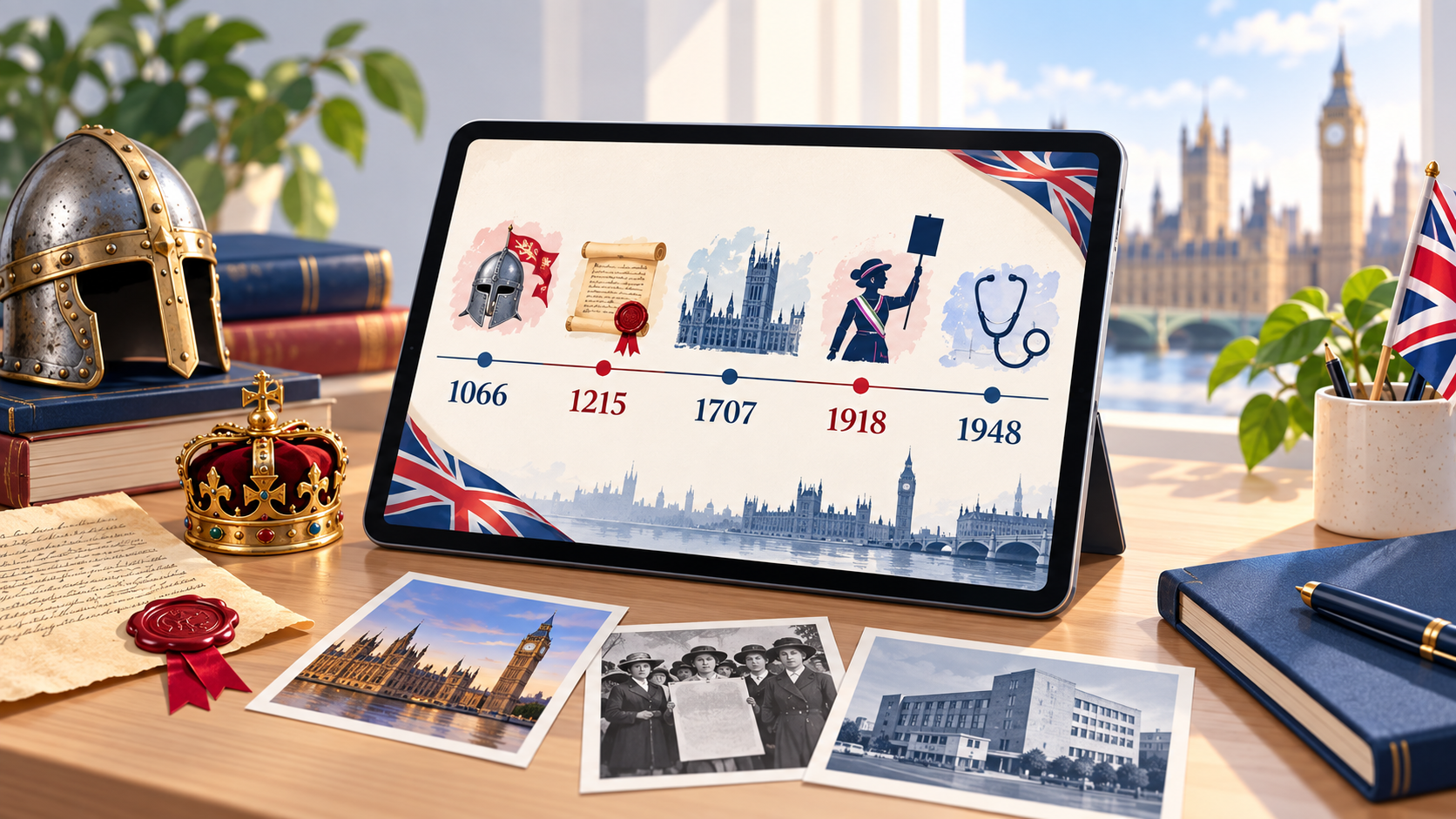
If British history is the part of your Life in the UK revision that turns into a blur of years, start with a timeline rather than a pile of isolated numbers. The useful skill is being able to see a date such as 1707 and immediately connect it to the event, the people involved and what changed.
There is no official Home Office "top 50" list. GOV.UK's Life in the UK Test guidance says you will only be tested on information from the official Guide for New Residents. The 50 dates below are therefore a practical revision shortlist, not an official ranking or a prediction of your questions.
Use each date as an anchor. Learn the year and event first, then add one sentence explaining why it matters. If you need to check which edition you should be studying, see our guide to the official Life in the UK handbook.
1-10: Romans, Medieval Britain and the Tudors
| No. | Date | What to remember |
|---|---|---|
| 1 | 55 BC | Julius Caesar's first expedition to Britain. Caesar crossed from Gaul, but Rome did not conquer Britain at this point. |
| 2 | AD 43 | The Roman conquest begins under Emperor Claudius. This is the date to connect with the successful Roman invasion of Britain. |
| 3 | AD 410 | Roman rule in Britain comes to an end. Roman imperial administration and military support were withdrawn in the early fifth century. |
| 4 | 1066 | The Battle of Hastings. William, Duke of Normandy, defeated King Harold II and became William the Conqueror, beginning Norman rule in England. |
| 5 | 1215 | Magna Carta. King John agreed to the charter at Runnymede. It became an enduring landmark in the development of limits on royal authority and the rule of law. |
| 6 | 1314 | The Battle of Bannockburn. Robert the Bruce's Scottish army defeated the English army of Edward II during the Wars of Scottish Independence. |
| 7 | 1348 | The Black Death reaches Britain. The plague caused enormous loss of life and major social and economic disruption. |
| 8 | 1415 | The Battle of Agincourt. Henry V's English army defeated a larger French force during the Hundred Years' War. |
| 9 | 1455 | The Wars of the Roses begin. The dynastic struggle between the houses of Lancaster and York continued, with interruptions, into the late 15th century. |
| 10 | 1485 | The Battle of Bosworth. Henry Tudor defeated Richard III and became Henry VII, beginning the Tudor dynasty. |
A useful sequence to say aloud is 1066 → 1215 → 1314 → 1348 → 1415 → 1455 → 1485. You are moving from Norman conquest, to Magna Carta, to medieval wars and plague, then into the Wars of the Roses and the Tudors.
Want to see how these events connect to everything that came before and after? Explore the full free chronological timeline for Life in the UK Test revision in Life in the UK: ExamReady.
11-20: Reformation, the Stuarts and Civil War
| No. | Date | What to remember |
|---|---|---|
| 11 | 1536 | The Laws in Wales Act. Legislation in 1536, followed by further legislation in 1542, merged the legal jurisdictions of England and Wales. |
| 12 | 1560 | The Scottish Reformation Parliament. Parliament broke with papal authority and established Protestantism in Scotland. |
| 13 | 1588 | The Spanish Armada is defeated. The attempted Spanish invasion during Elizabeth I's reign failed. |
| 14 | 1603 | The Union of the Crowns. James VI of Scotland also became James I of England. The two kingdoms shared a monarch but remained separate states. |
| 15 | 1605 | The Gunpowder Plot. The plan to blow up King James I and Parliament was discovered, with Guy Fawkes arrested in the cellars below Parliament. |
| 16 | 1642 | The English Civil War begins. Armed conflict broke out between supporters of Charles I and Parliament. |
| 17 | 1649 | Charles I is executed. England entered a period without a king, including the Commonwealth and Protectorate. |
| 18 | 1660 | The Restoration. Charles II returned from exile and the monarchy was restored. |
| 19 | 1665 | The Great Plague. London suffered its last major outbreak of bubonic plague. |
| 20 | 1666 | The Great Fire of London. The fire began on 2 September and destroyed a large part of the City of London. |
The distinction between 1603 and 1707 matters. In 1603 England and Scotland shared a monarch. They did not become one kingdom with one Parliament until the Acts of Union took effect in 1707.
If these dates are starting to blur together, use the built-in flashcards in Life in the UK: ExamReady to practise recalling the event from the year, and the year from the event.
21-30: Parliament, Union, the Jacobites and Napoleon
| No. | Date | What to remember |
|---|---|---|
| 21 | 1688 | The Glorious Revolution. William of Orange arrived in England and James II fled. |
| 22 | 1689 | The Bill of Rights. It placed important limits on the Crown and affirmed rights and liberties of Parliament. |
| 23 | 1690 | The Battle of the Boyne. William III defeated the forces of the deposed James II in Ireland. |
| 24 | 1707 | The Acts of Union unite England and Scotland. From 1 May, the two kingdoms became the Kingdom of Great Britain with one Parliament. |
| 25 | 1745 | The Jacobite Rising led by Charles Edward Stuart. "Bonnie Prince Charlie" landed in Scotland and the Jacobites advanced into England. |
| 26 | 1746 | The Battle of Culloden. Government forces defeated the Jacobite army, ending the 1745 rising. |
| 27 | 1801 | Union with Ireland takes effect. Acts passed in 1800 came into force on 1 January 1801, creating the United Kingdom of Great Britain and Ireland. |
| 28 | 1805 | The Battle of Trafalgar. Admiral Nelson's British fleet defeated the combined French and Spanish fleets. Nelson was killed in the battle. |
| 29 | 1807 | The slave trade is abolished in the British Empire. The Abolition of the Slave Trade Act made British participation in the transatlantic slave trade unlawful. It did not abolish slavery itself. |
| 30 | 1815 | The Battle of Waterloo. Napoleon was defeated by allied forces led by the Duke of Wellington and the Prussian commander Marshal Blücher. |
Three dates here are easy to mix up: 1707 is union with Scotland, 1801 is the union with Ireland taking effect, and 1807 concerns abolition of the slave trade.
31-40: Reform, the Victorian era and voting rights
| No. | Date | What to remember |
|---|---|---|
| 31 | 1832 | The Great Reform Act. It redistributed parliamentary seats and broadened the male electorate, while still leaving most working men without the vote. |
| 32 | 1833 | The Slavery Abolition Act is passed. It came into force in 1834 across most British colonies. An apprenticeship system meant full emancipation was delayed for many people until 1838. |
| 33 | 1837 | Queen Victoria comes to the throne. Her reign lasted until 1901 and gave its name to the Victorian era. |
| 34 | 1851 | The Great Exhibition. The international exhibition opened in the Crystal Palace in London's Hyde Park. |
| 35 | 1867 | The Second Reform Act. It expanded the male electorate and roughly doubled the number of men entitled to vote in England and Wales. |
| 36 | 1914 | Britain enters the First World War. The United Kingdom declared war on Germany on 4 August 1914. |
| 37 | 1916 | The Easter Rising. Irish republicans occupied buildings in Dublin and proclaimed an Irish Republic. |
| 38 | 1918 | The First World War ends and voting rights expand. The war ended on 11 November. The Representation of the People Act gave the parliamentary vote to all men over 21 and to some women over 30 who met the required qualification. |
| 39 | 1922 | The Irish Free State is established. Six counties in the north remained part of the United Kingdom as Northern Ireland. |
| 40 | 1928 | Women gain the parliamentary vote on the same terms as men. The Equal Franchise Act extended the vote to women aged 21 and over. |
Do not merge 1918 and 1928 into one fact. In 1918 some women over 30 gained the vote. In 1928 women received the parliamentary franchise on the same age terms as men.
41-50: The Second World War, welfare state and modern UK
| No. | Date | What to remember |
|---|---|---|
| 41 | 1939 | Britain enters the Second World War. The United Kingdom declared war on Germany on 3 September 1939 after Germany invaded Poland. |
| 42 | 1940 | Churchill, Dunkirk and the Battle of Britain. Winston Churchill became Prime Minister in May, the Dunkirk evacuation took place in May and June, and the Battle of Britain followed that summer and autumn. |
| 43 | 1942 | The Beveridge Report. William Beveridge's report proposed a broad programme of social security reform and influenced post-war welfare policy. |
| 44 | 1944 | D-Day. Allied forces landed in Normandy on 6 June 1944, opening a major western front against Nazi Germany. |
| 45 | 1945 | The Second World War ends. Victory in Europe came in May, the war against Japan ended later in the year, and Clement Attlee became Prime Minister after Labour's general election victory. |
| 46 | 1948 | The NHS begins and the Empire Windrush arrives. The National Health Service launched on 5 July. The Empire Windrush passengers disembarked at Tilbury on 22 June, an important moment in the history of post-war Caribbean migration to Britain. |
| 47 | 1969 | The voting age is reduced from 21 to 18. The Representation of the People Act 1969 made 18 the minimum age for voting in UK parliamentary elections. |
| 48 | 1998 | The Belfast/Good Friday Agreement. The agreement was reached on 10 April 1998 as a central part of the Northern Ireland peace process. |
| 49 | 1999 | Devolution takes effect. The Scottish Parliament and National Assembly for Wales took responsibility for devolved powers in July; powers were transferred to the Northern Ireland Assembly in December. |
| 50 | 2020 | The United Kingdom leaves the European Union. The UK left the EU on 31 January 2020. The current official handbook addendum removes older sections that describe the UK as an EU member or explain EU institutions, so do not revise from an old copy that still treats membership as current. |
That final point is worth handling carefully. The official TSO page for the current 3rd edition records the UK's departure from the EU and explains that outdated EU-membership material has been removed from subsequent prints. It also says sections referring to Queen Elizabeth II and the Monarchy are out of date and have been removed. This is why an old PDF or an old revision website can give you material that no longer matches the current handbook.
The Six Date Pairs Most Worth Separating
If you already know most of the list, spend your next revision session on the dates that look alike or describe related changes.
- 1603 vs 1707: Union of the Crowns vs political union of England and Scotland.
- 1707 vs 1801: Great Britain is created vs union with Ireland takes effect.
- 1807 vs 1833: abolition of the slave trade vs the Act abolishing slavery across most British colonies.
- 1918 vs 1928: some women over 30 gain the vote vs women vote on the same age terms as men.
- 1942 vs 1948: Beveridge Report vs the launch of the NHS.
- 1998 vs 1999: Belfast/Good Friday Agreement and devolution legislation vs devolved institutions taking on their powers.
These distinctions are more useful than memorising a long string of years with no context. If you can explain both sides of each pair without looking, you are much less likely to confuse them in a multiple-choice question.
How to Memorise the Dates Without Cramming All 50 at Once
Start with five blocks of ten, matching the sections above. Do not move on because a date merely looks familiar. You should be able to produce the event before checking the answer.
- Learn date → event. Look at "1215" and say "Magna Carta".
- Reverse it: event → date. Ask yourself "When was Magna Carta agreed?" and produce "1215".
- Add one significance sentence. For 1707, for example: England and Scotland became the Kingdom of Great Britain with one Parliament.
- Mix the periods. Once a block feels secure, shuffle dates from different centuries so you are recalling the fact rather than remembering its position in a list.
- Drill the confusion pairs. Give extra attention to 1603/1707, 1707/1801, 1807/1833, 1918/1928, 1942/1948 and 1998/1999.
Our Life in the UK Test flashcard guide explains a fuller recall-based revision method. If a date still feels detached from the story around it, use the UK values, history and culture guide to put the event back into context.
Use the Official Handbook as the Source of Truth
A date list is a revision aid. It is not a substitute for the official handbook.
GOV.UK states that the test questions are based on the official Guide for New Residents. The safest workflow is therefore:
- Study the relevant handbook section.
- Use this list to compress the history into memorable anchors.
- Test yourself in both directions: date to event and event to date.
- Return to the handbook when you cannot explain why an event matters.
- Use practice questions to find gaps that a timeline alone will not expose.
This matters because the Life in the UK Test covers far more than chronology. Government, law, values, geography, traditions, culture and important people can all appear in the handbook. Once the dates are under control, keep moving through the rest of the syllabus rather than polishing one topic indefinitely.
If your test is already booked, our Life in the UK Test day guide covers the separate job of preparing for the appointment itself.
Download
Life in the UK: ExamReady includes a searchable chronological history timeline and built-in flashcards. For date revision, work through the timeline in order, then use flashcards to check whether you can recall each event without seeing it first. After that, move to practice questions so the dates are tested in context.
Ready to pass first time?
Master the Life in the UK test with realistic mock tests, a full study guide, smart flashcards, and performance insights.